Key takeaways
- A resale unit's real price is the cash to the seller plus everything still owed to the developer, plus the transfer fee.
- Get the developer's own statement of what is paid and owed, and the full chain of contracts, before you pay anything.
- Compare the real price per m² with what the developer is asking for similar new units today.
Last reviewed 2026-11-03 · Reviewed every 6 months · REONE editorial. General information, not legal, tax or investment advice.
A resale listing in Egypt often shows one number: the cash the seller wants. That number hides the rest of the price, which is still owed to the developer, plus fees and arrears that can land on you. This guide shows how to work out the real price of one resale unit and what to check before you pay.
If you are still deciding between resale and buying from the developer, start with resale or developer. This guide assumes you have a specific unit in front of you.
The quick answer
Real price = cash to the seller + remaining instalments to the developer + the developer's transfer fee + any unpaid maintenance or utility amounts you take on. Divide it by the unit's area and compare that price per m² with similar units sold by the developer now.
Step 1: get the developer's statement of account
The seller's word is not enough. Ask the seller to request, from the developer, a written statement of account for the unit showing:
- The original contract price and the unit's area as stated in the contract.
- Every amount paid so far, and every instalment still due, with dates.
- Any late instalments, late-payment charges or bounced cheques.
- Whether the maintenance deposit has been paid, and how much.
Late instalments matter. A legal study of more than 40 developer contracts found clauses that let the developer keep up to 30% of the unit's total price if a contract is cancelled (Observed, Egypt Telegraph, 19 September 2026). If the seller is behind, the unit you are buying could be at risk before the transfer goes through.
Step 2: ask about the transfer fee ()
Most developers charge a fee to approve moving the contract from the seller to you, known as the assignment or tanazol (). The same study found transfer fees in the contracts it analysed ranging from 1% to 5% of the unit's value (Observed, Masrawy, 19 September 2026). Ask the developer:
- The exact fee, and whether it is a percentage of the original contract price or of today's price.
- Who pays it. This is negotiable, so put the answer in your agreement with the seller.
- Any conditions, such as a minimum share of the price paid before a transfer is allowed.
If the unit was allocated by the New Urban Communities Authority (NUCA), the city authority charges its own transfer fees. NUCA announced temporary reductions on these in September 2024 (Observed, Ministry of Housing real estate portal, 22 September 2024); ask the city authority for the current amount.
Step 3: check the contract chain
Ask to see, in originals:
- The original contract between the developer and the first buyer.
- Every later assignment, each approved by the developer, so the chain runs unbroken to the person selling to you.
- The seller's national ID, matching the name on the last approved contract.
- If the seller is acting for someone else, a valid power of attorney that covers selling.
A gap in the chain, or a "paper sale" the developer never approved, means the developer does not recognise the seller as the owner. Have a lawyer review the documents. The contract checklist lists what to read in the developer's contract itself.
Step 4: check maintenance and utilities
- Maintenance deposit. If it is unpaid, you will owe it, usually at delivery. Agree in writing who pays it.
- Service charges. For a delivered unit, ask the compound's management for a clearance showing no unpaid charges.
- Utilities. Ask for the last paid electricity, water and gas bills, and check the meters are installed and in the seller's name or the developer's.
Step 5: compare the price per m²
Divide the real price from Step 1 to Step 4 by the unit's area from the contract. Make sure you compare like with like: the same type of area (built-up area including a share of common space, or net area), the same finishing and a similar delivery stage. See price per square metre explained.
Then compare with what the developer, and other sellers, ask for similar units today. REONE's Market Index shows asking price per m² by area. These are asking prices, not sale prices.
The same study noted that some developers re-offer units in the same project to new buyers with lower down payments and longer plans (Observed, Masrawy, 19 September 2026). If the developer is selling a similar unit with an easy plan, your resale price needs to be clearly better to be worth paying in cash up front.
Worked example (Calculated)
Every input is an assumption chosen to show the method, not a REONE or market price.
- Original contract price: EGP 5,000,000 for 130 m².
- Paid by the seller so far: EGP 2,000,000.
- Seller's asking price in cash: EGP 3,200,000.
- Developer's transfer fee: 3% of the original contract price.
- Maintenance deposit: 8% of the contract price, not yet paid.
| Line | How it is worked out | EGP |
|---|---|---|
| Still owed to the developer | 5,000,000 − 2,000,000 | 3,000,000 |
| Seller's premium over what they paid | 3,200,000 − 2,000,000 | 1,200,000 |
| Transfer fee | 3% × 5,000,000 | 150,000 |
| Real price | 3,200,000 + 3,000,000 + 150,000 | 6,350,000 |
| Real price per m² | 6,350,000 ÷ 130 | 48,846 |
| Unpaid maintenance deposit | 8% × 5,000,000 | 400,000 |
| Real price including the deposit | 6,350,000 + 400,000 | 6,750,000 |
What the example shows:
- The headline EGP 3,200,000 is about half of what you will really pay.
- You pay EGP 1,350,000 more than the original buyer, 27% above the original contract price (1,350,000 ÷ 5,000,000).
- Compare the EGP 48,846 per m² with the developer's asking price per m² for a similar new unit, leaving the deposit out of both, since a new unit also carries one.
- The EGP 3,000,000 still owed is paid over the remaining plan, not today. A fair comparison counts that timing; the payment plans guide explains how.
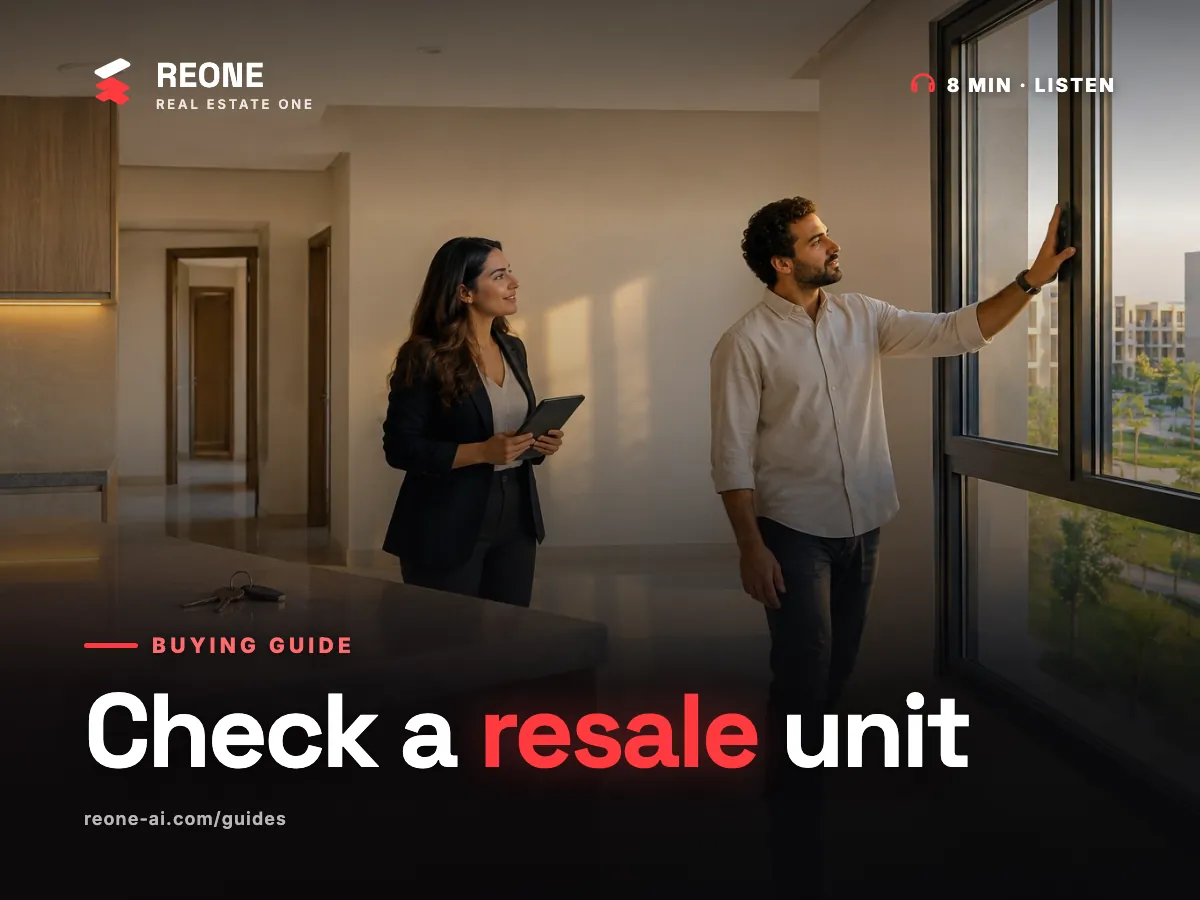
Step 6: inspect the unit
For a delivered unit, visit in daylight and, if you can, with an engineer:
- Damp or cracks in walls and ceilings, especially around bathrooms and the kitchen.
- Water pressure, drainage and electricity in every room.
- Windows, doors and the finishing against what the contract promised.
- Any changes the seller made, such as moved walls or a closed balcony, that the developer or compound rules might not allow.
For an undelivered unit, visit the building and compare progress with the delivery date. Our guide on checking delivery dates shows how.
Mistakes to avoid
- Paying a deposit to the seller before the developer confirms what is owed.
- Comparing the seller's cash figure with a full price elsewhere.
- Assuming the developer will approve the transfer without asking.
- Leaving "who pays the transfer fee" and "who pays the maintenance deposit" out of the agreement.
- Forgetting that the 2.5% real estate disposal tax is the seller's by law (Observed, Andersen Egypt, 8 June 2021); do not let it slip into your side of the deal unannounced.
Frequently asked questions
Who pays the developer's transfer fee in a resale?
There is no fixed rule. It is negotiated between buyer and seller, so write the answer into your agreement. Ask the developer for the exact amount first.
Can I take over the seller's remaining instalments?
Usually yes, once the developer approves the transfer. The remaining instalments then follow the original plan. Confirm the schedule in the developer's statement of account.
Is a resale unit cheaper than buying from the developer?
Not always. Work out the real price per m² as in the example above and compare it with the developer's current asking price for a similar unit, then weigh delivery timing and payment terms. How to negotiate helps if the numbers are close.
Where can I find resale units on REONE?
REONE lists units for sale from several sources, including resale. Ask Nour or Zaki which units are available in a compound.
Sources and method
- Real estate market crisis: study reveals the impact of transfer fees of up to 5%, Masrawy, 19 September 2026, reporting a study by Saada & Abu El-Qomsan law firm (accessed 3 November 2026).
- 10% maintenance deposit and 30% cancellation penalty, Egypt Telegraph, 19 September 2026, on the same study of more than 40 developer contracts (accessed 3 November 2026).
- New Urban Communities Authority approves fee reduction for property transfers, Ministry of Housing real estate portal, 22 September 2024 (accessed 3 November 2026).
- Tax on real estate disposition, Andersen in Egypt, 8 June 2021 (accessed 3 November 2026).
Method: the worked example uses stated assumptions. Transfer fees and contract terms differ by developer and project; the 1-5% range describes the contracts one law firm analysed, not a legal limit. This guide is not legal advice.